Why Discipline Matters More Than Strategy in Trading
@AfshinTaherIII2026-09-01T09:57:33+00:00Discover why discipline matters more than strategy in trading and how emotional control, consistency, and risk management can improve your trading mindset.
In trading, everyone is looking for the perfect strategy. The perfect indicator. The perfect entry. The perfect setup. But experienced traders eventually discover something more important: A good strategy means very little without discipline. You can have a profitable trading system and still lose money if you cannot follow your own rules. You can have a great understanding of the market and still make poor decisions because of fear, greed, impatience, or overconfidence. Trading is not only a battle against the market. It is a battle against yourself. And that is why discipline matters so much.
What Does Discipline Mean in Trading?
Trading discipline means having the ability to follow your trading plan consistently — especially when your emotions are telling you to do something else. A disciplined trader does not need to predict every market movement. Instead, they focus on controlling what they can control:
- When to enter a trade
- When to exit a trade
- How much to risk
- Where to place a stop loss
- When not to trade
- How to respond after a loss
- How to protect profits
- When to walk away from the market
Discipline is not about being right all the time. It is about following your process even when you are wrong.
Strategy vs. Discipline: Which One Matters More?
A trading strategy gives you a framework for making decisions. It may tell you:
“Enter when these conditions are met.”
But discipline determines whether you actually follow that rule. Imagine two traders using exactly the same strategy. Trader A follows the rules consistently. Trader B changes the rules whenever the market moves against them. The strategy is identical. The results can be completely different. This is one of the biggest lessons in trading:
Your strategy creates the opportunity. Your discipline determines how consistently you execute it.
How Emotions Affect Trading Decisions
Markets can trigger powerful emotions. A profitable trade can create excitement and overconfidence. A losing trade can create fear, frustration, or the desire to immediately recover the loss. This emotional cycle can lead to some of the most common trading mistakes.
Fear
Fear can cause traders to close profitable positions too early or avoid valid setups.
Greed
Greed can encourage traders to take excessive risk or stay in a position longer than their plan allows.
FOMO
Fear of missing out can cause traders to enter a trade simply because the market is moving.
Revenge Trading
After a loss, some traders try to win the money back immediately by taking larger or lower-quality trades.
Overconfidence
After a series of successful trades, a trader may begin taking risks that would normally be outside their trading plan. The market does not need to force you into these decisions. Your emotions can do it for you.
Discipline Over Emotion
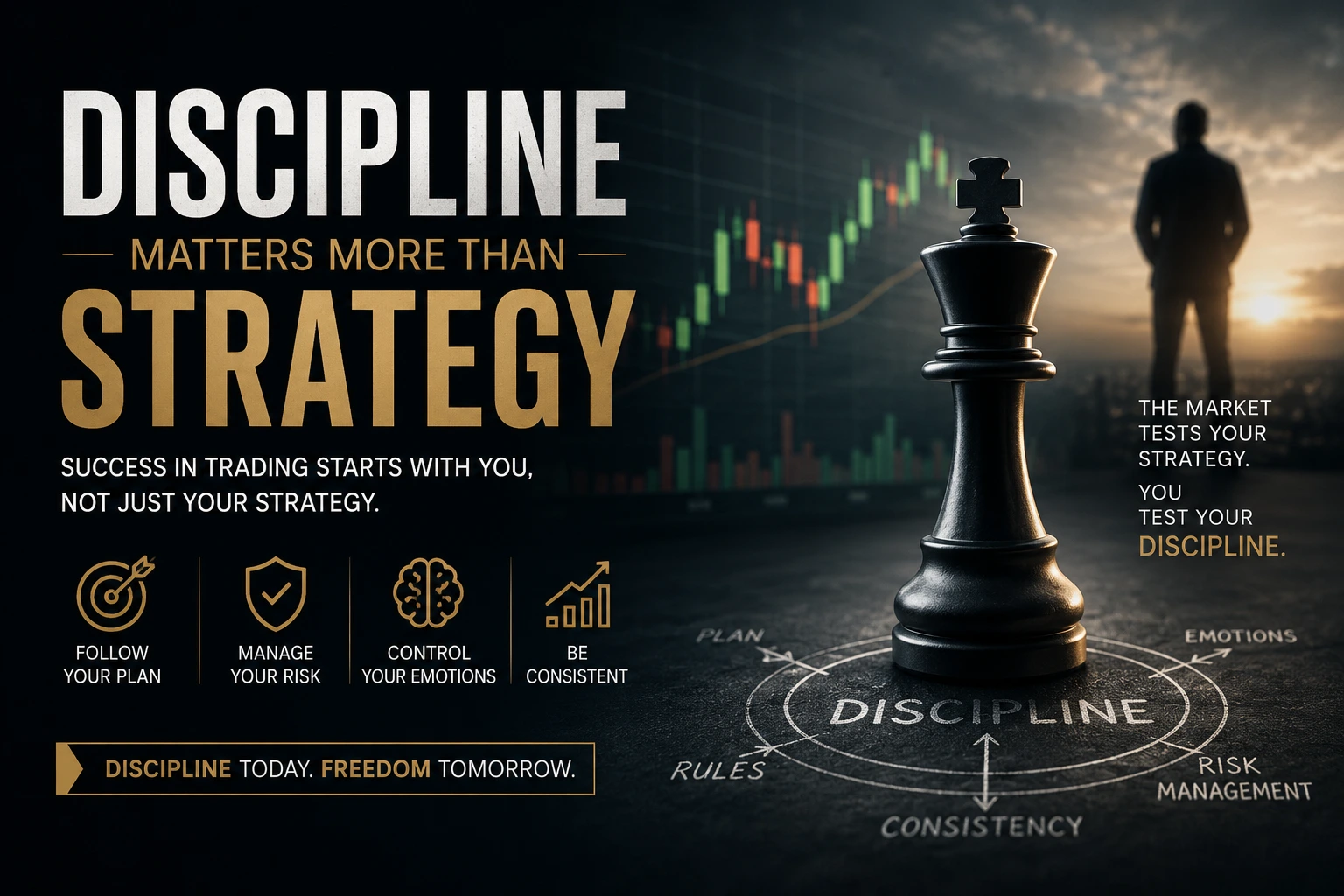
One of the most important principles a trader can develop is simple: Discipline over emotion. This does not mean eliminating emotions. That is unrealistic. Fear, excitement, frustration, and uncertainty are normal human reactions. The goal is to prevent those emotions from controlling your decisions. A disciplined trader can feel fear and still follow their risk management rules. They can experience a losing trade without immediately trying to recover the money. They can watch the market move without feeling the need to participate in every move. The goal is not to become emotionless. The goal is to become consistent.
Why Traders Lose Money Even With a Good Strategy
Many traders assume that losing money means their strategy is bad. Sometimes it is. But not always. A strategy can have a positive long-term expectancy and still produce losing trades. Losses are a normal part of trading. The problem begins when traders stop following the strategy. For example: A trader’s plan says to risk 1% of their account on each trade. After several losses, they become frustrated and decide to risk 5% on the next trade. The strategy did not change. The behavior did. This is why risk management and discipline are closely connected. A trader does not need to avoid every loss. They need to prevent one emotional decision from turning a normal loss into a devastating one.
Consistency Is More Important Than One Big Win
Trading can make people focus too much on individual trades. One huge winning trade feels exciting. One large loss feels devastating. But professional trading is not about one trade. It is about a series of decisions over time. A disciplined trader asks:
“Did I follow my plan?”
rather than:
“Did I make money?”
That distinction is powerful. You can follow your plan perfectly and still lose a trade. You can break every rule and still make money on a trade. The first is good trading. The second is dangerous. A profitable mistake is still a mistake.
The Role of Risk Management
Discipline becomes especially important when it comes to risk management. A trading plan should define how much you are willing to lose before you enter a position. This can include:
- Position size
- Stop-loss level
- Maximum risk per trade
- Maximum daily loss
- Risk-to-reward considerations
- Maximum number of trades
The exact rules depend on the trader and their strategy. But the principle remains the same: Protect your capital first. You cannot continue trading if one emotional decision destroys your account.
How to Build Better Trading Discipline
Discipline is not something you either have or do not have. It can be developed through habits and systems.
1. Create a Trading Plan
Write down your rules before you enter the market. Your plan should clearly define your setup, entry, exit, risk, and conditions for staying out of the market. When your rules are written down, you have something objective to follow.
2. Use a Trading Journal
Record your trades and, more importantly, record your decisions. Ask yourself:
- Why did I enter?
- Did the trade meet my rules?
- How much did I risk?
- What was I feeling?
- Did I follow my plan?
- What can I improve?
Over time, patterns in your behavior become easier to identify.
3. Accept That Losses Are Part of Trading
No strategy wins every trade. Once you accept that losses are part of the process, you become less likely to make emotional decisions after a losing position.
4. Stop Chasing the Market
You do not need to trade every opportunity. Sometimes the best trade is no trade. If the setup is not there, wait. Patience is a trading skill.
5. Focus on Process, Not Results
Instead of judging yourself by today’s profit or loss, ask whether you executed your plan correctly. A strong process creates consistency. Consistency creates the possibility of long-term results.
The Mindset of a Disciplined Trader
A disciplined trader understands that the market cannot be controlled. Price can move unexpectedly. News can change market conditions. A perfect setup can fail. A winning streak can end. The only thing a trader can truly control is their own behavior. That is why successful trading requires more than technical knowledge. It requires patience. It requires risk management. It requires emotional control. And above all: It requires discipline.
Discipline Over Emotion
At TradingShirt, we believe trading is more than charts and numbers. It is a mindset. The market rewards preparation, patience, risk management, and consistency — but it does not guarantee success. Every trader faces uncertainty. Every trader experiences losses. Every trader has moments when emotion becomes louder than logic. The difference is what happens next. Do you follow your plan? Or do you follow your emotions? Discipline over emotion. Consistency over impulse. Process over prediction. Because in trading, your biggest challenge is not always the market. Sometimes, it’s you.
Final Thoughts
There is no perfect trading strategy. There is no indicator that can eliminate uncertainty. And there is no trader who wins every trade. But you can build a process. You can manage your risk. You can learn from your mistakes. And you can become more consistent. The goal is not to predict every move. The goal is to make better decisions, repeatedly. That is what discipline means. And that is what separates a reaction from a process. Wear the mindset.
Frequently Asked Questions
Is discipline more important than strategy in trading?
Both strategy and discipline are important. A strategy provides a framework for making trading decisions, while discipline helps a trader execute that strategy consistently and manage risk.
Why is discipline important in trading?
Trading discipline helps prevent emotional decisions caused by fear, greed, FOMO, frustration, and overconfidence. It allows traders to follow their trading plan and maintain consistent risk management.
How can I become a more disciplined trader?
Creating a written trading plan, keeping a trading journal, using consistent risk management, accepting losses, and focusing on process rather than individual results can help develop better trading discipline.
What is discipline over emotion in trading?
“Discipline over emotion” means following your predefined trading rules instead of allowing fear, greed, FOMO, or frustration to determine your decisions.
Can a good trading strategy work without discipline?
A good strategy can still produce poor results if it is not executed consistently. Discipline is essential because even a strong strategy requires proper risk management and consistent execution.
TRADINGSHIRT